
Infielders are often told to look for a good hop. But how many infielders actually know what a good hop is and how to get it?
There are two types of good hops:
- Short Hop – immediately after the baseball has hit the ground.
- Long Hop – after the ball has reached the top of its arc and is moving downward.
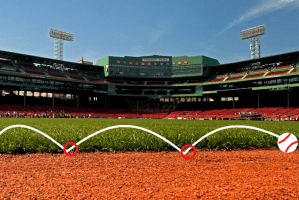
In the image below, the short hop is the area inside the red circle right after the ball hits the ground.
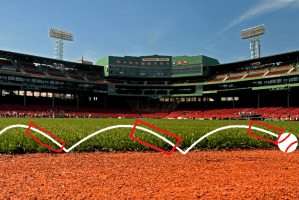
The long hop is the area inside the red rectangle when the ball is moving downward after reaching the top of the arc.
What makes a good hop versus a bad hop is the ability to read what the ball is going to do. The short hop is easier to field because the ball does not have time to move in an unexpected direction if you catch it immediately after it hits the ground. A long hop is easier to field because we have more time to watch the ball, judge its direction and speed, and adjust to make the catch.
A bad hop refers to an in-between hop. This is the part of the hop when the ball is moving upward after hitting the ground. This ball is more difficult to catch because the infielder has only a fraction of a second to judge the direction of the ball and react. The in-between hop is more likely to “eat up” the fielder. When you see an infield error, how often does it look like the ball took the player by surprise? This is usually because they did not have time to read the hop and guessed wrong about where it was going.
Click here for a good explanation and discussion of these three types of hops. Below is another video explaining the three types of hops with examples of in-between hops in MLB games.
In the video below, “Great Plays on Bad Hops,” notice that most of the “bad hops” are in-between hops. Yes, these infielders make the play, but the in-between hops make catching the ball much more difficult.
The goal of the infielder is to get a short or long hop. To make this more likely, infielders need to be able to adjust to the baseball ball as they try to read it. There are several ways infielders can make themselves more adjustable. They include:
 Improve Your Hitting