

For more about information and drills to improve barrel control, see Barrel Control – Launch Angle.
Barrel control includes producing swing paths that allow you to hit the baseball to different parts of the field.
Hitting the Baseball to All Parts of the Field
Hitting to all parts of the field is an important skill. Certain pitches are usually easier to hit pull side, up the middle, or opposite field. Game situations sometimes present opportunities that require hitting the ball in a certain direction. There may be a hole in the outfield or you want to hit behind the runner. Being able to hit the ball to a given part of the field is something that needs to be understood and practiced to be success.
In general, to pull the ball you need to make contact with the ball in front of your body. To hit to the opposite field, you need to let the ball get deeper. The direction of the barrel at contact determines the direction of the baseball. The horizontal swing path is an arc. Consequently, the bat will be pointed towards the opposite field earlier in the swing and towards the pull side later in the swing. See the diagram below.
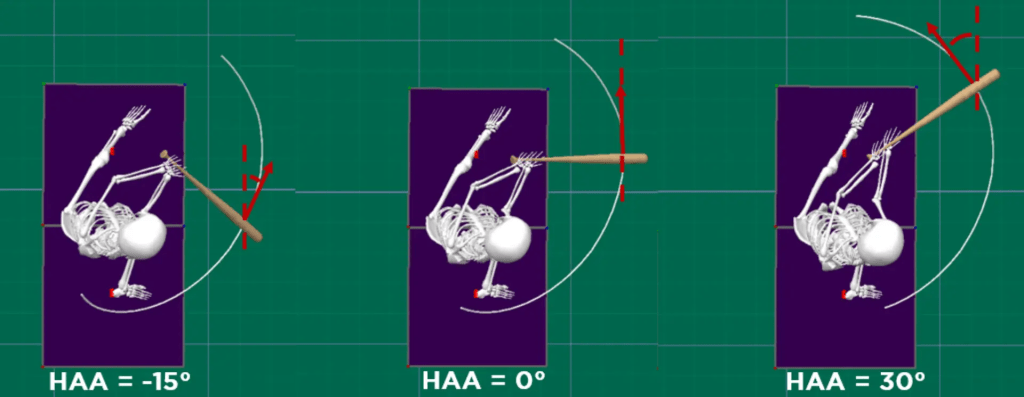
The best contact points to hit the ball in a particular direction will differ slightly from player to player depending on their physiques and swing mechanics. You should play with tee placements to figure out where you need to make contact to hit the ball hard to different parts of the field.
In the diagram below, you see an example of contact points for hitting. It is important to note that these will differ depending on where you set up on the batter’s box. If you stand back in the batter’s box, then the contact points will also move back. For reference, the middle-middle contact point should line up about where the heel of your stride foot lands. The other contact points are either in front or behind your stride foot.

— DIAGONAL TEE PLACEMENT DRILL —
This drill will help you understand the contact points where you most effectively hit baseballs to all parts of the field.
Get in your normal batting stance in front of home plate. Mark where your back foot is. Take a normal swing and note where your front heel lands. Place the tee even with your front heel in line with the middle of the plate. This will be the middle position in the diagonal. See the diagram above. Move the tee along the diagonal to hit to right field, right-center, center field, left-center, and left field. Use the diagonal as a guide but don’t feel like you have to follow it exactly. Find the spots on the plate where you can hit to all five parts of the field with the most power. Always set up in your stance in the same place with your back foot on the mark. Move the tee around. Do not move where you set up your feet in your stance. Your goal for each swing is to hit hard line drives.
The video below describes using the diagonal method to hit to all parts of the field.
— OFFSET ROTATION HITTING DRILL —
The Offset Rotation hitting drill is great for helping you hit more effectively to all fields. Offset Open forces you to get your bat on plane early to hit line drives up the middle. Offset Closed forces you to keep you bat on plane longer to hit line drives up the middle. You can do this drill with soft front toss or a tee. If you use a tee, put your front foot even with the tee for all three positions (open, regular, and closed). Also, adjust the tee height. Use a no stride for this drill. Swing hard and hit every ball up the middle.
— BATTING PRACTICE —
Use batting practice (soft toss, front toss, and machines) to work on hitting to all parts of the field. You should be intentional about where you are trying to hit the ball. Remember that certain pitches are going to be easier to hit to certain parts of the field.
- Inside pitch – pull side.
- Middle pitch – up the middle.
- Outside pitch – opposite field.
 Improve Your Hitting